Why accommodation in Oman starts with a choice beyond Muscat
Accommodation in Oman rewards travelers who think in regions rather than just in one city. While Muscat offers the best concentration of international hotels and polished service, the most memorable stay in Oman often happens where the road thins, the stars sharpen, and the silence becomes part of the experience. When you plan your stay Oman itinerary, the first decision is how many nights you will give to each landscape rather than which single hotel to book.
Across Oman there are significantly more regional hotels than hotels in Muscat, and that imbalance tells you where the country’s hospitality soul really lives. According to the Ministry of Heritage and Tourism’s “Tourism Statistics Bulletin 2022,” Muscat accounts for about one third of classified hotel establishments, with the remaining two thirds spread across governorates such as Dhofar, Al Dakhiliyah, and Ash Sharqiyah (see “Statistical Indicators – Tourism Establishments,” Ministry of Heritage and Tourism, 2022). Regional hotels in Oman have been designed around specific terrains — mountain rims, desert dunes, frankincense valleys, turtle beaches — and each area delivers something no hotel Muscat property can replicate, however refined its lobby. This is why travelers who only stay Muscat often leave with a polished city experience but miss the deeper layers that make accommodation Oman genuinely distinctive.
Think of Muscat as your gateway, not your whole story, especially if you are planning a longer trip Oman with family. The city works beautifully for a first or last stay, close to Muscat Airport and the diplomatic quarter, with easy access to Qurum Beach and the Corniche. Yet the best places to sleep, swim, and feel the country’s rhythm often sit several hours away, where hotels Oman lean into altitude, dunes, or monsoon mist rather than marble and chandeliers.
Jabal Akhdar and the Hajar mountains: altitude as the quiet luxury
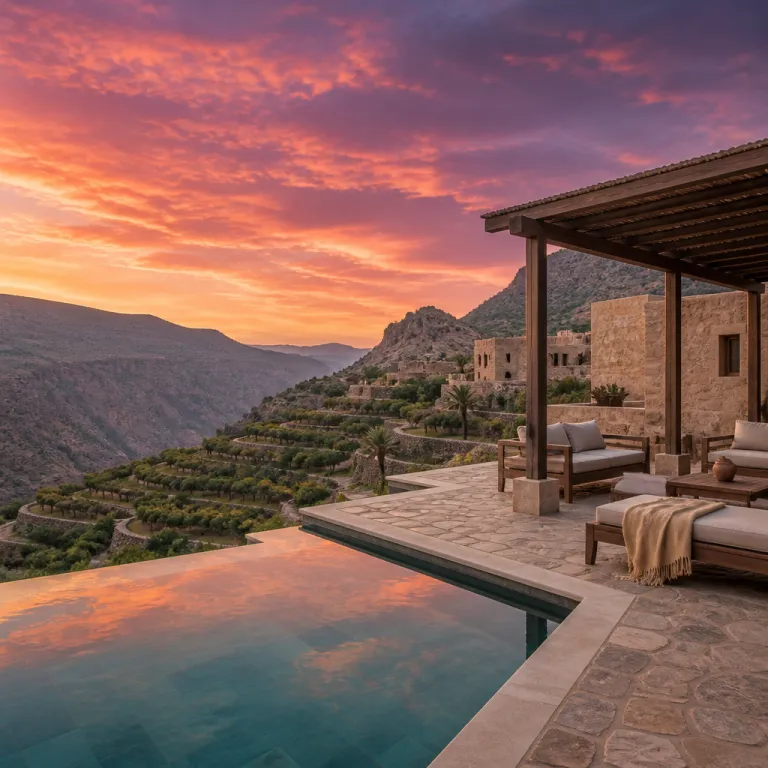
In Jabal Akhdar and the wider Hajar range, accommodation in Oman becomes an altitude driven experience that Muscat simply cannot match. Up here, the air is typically 15 to 20 °C cooler than the coast, and luxury hotels cling to canyon edges where sunrise pours straight into your room. A stay in this mountain area is less about an outdoor pool and more about terraces, fire pits, and cliffside paths where children can walk safely while parents finally exhale.
The best hotels on Jabal Akhdar and nearby Jabal Shams turn geography into an amenity, with villas angled toward the canyons and infinity pools that feel suspended above the rock. Properties such as Alila Jabal Akhdar and Anantara Al Jabal Al Akhdar Resort are typical of this style, with guided hikes and via ferrata routes built into their daily programs. These luxury resorts are ideal for families who want structured days — guided hikes, village visits, stargazing — and quiet evenings, and they offer a depth of mountain experience that no hotel Muscat can rival, however strong the Muscat offers on price. When you book your stay Oman itinerary, two or three nights here create a natural pause between the city and the desert.
For premium families balancing budget and comfort, this region also hosts smaller mountain hotels Oman that sit below the ultra luxury tier yet still deliver strong value. Jabal Akhdar lies about 150 km from Muscat, and the drive from Muscat Airport to the plateau typically takes around 2.5 hours by 4x4, which most hotels can arrange as a private transfer. You can check seasonal offers, because shoulder months often bring excellent rates compared with peak weekends when residents from Muscat escape the heat. If you are planning a multi region trip Oman, think of Jabal Akhdar as your cool anchor, the place where children sleep deeply and screens finally lose their grip.
Sharqiya Sands and the desert: where nights camp become the main event
Once you leave the coast for Sharqiya, also known as Wahiba Sands, accommodation in Oman shifts from walls and corridors to dunes and canvas. Here, the best places to stay are not defined by thread count alone but by how quickly the staff remember your names, how quietly the generator hums, and how dark the sky becomes once the last lantern is dimmed. A desert stay in this area is the opposite of a city break in Muscat, and that contrast is exactly the point.
Luxury resorts in Wahiba Sands often operate as tented suites with private decks facing the dunes, and families can book a nights camp package that includes dune drives, camel walks, and Bedouin style dinners under the stars. Desert Nights Camp, for example, sits about 11 km inside the dunes from the Al Wasil meeting point and typically bundles 4x4 transfers with activities in its rates. This is where the phrase accommodation Oman gains its most cinematic meaning, because no hotel Muscat can offer the feeling of stepping from your bed directly onto cool sand at dawn. For those watching their budget, there are also well run budget hotels and simpler camps that still provide clean tents, good food, and safe dune access, proving that a desert experience does not have to be exclusive to the top tier.
Regional hoteliers here understand that travelers want authenticity without discomfort, and they design stays around that balance. As the Ministry of Heritage and Tourism notes in its tourism establishment summaries, regional hotels offer experiences like desert camping, mountain retreats, and cultural immersion that go beyond standard city stays. When you plan your trip Oman, allocate at least one or two nights in Wahiba Sands, because a single evening is rarely enough for children to relax into the rhythm of the dunes and for adults to feel the full reset that only the desert can deliver.
Salalah and Dhofar: khareef, frankincense, and the southern frontier
Far to the south, Salalah and the Dhofar region redefine accommodation in Oman again, this time through monsoon mist and Indian Ocean light. During the khareef season, when the hills turn green and clouds sit low over the coast, hotels in this area feel closer to a subtropical retreat than to the dry landscapes around Muscat. Families who stay in Salalah during this period often feel as if they have found a different country within the same borders.
The best hotels along the Salalah beach strip combine long crescents of sand with large gardens, kids’ clubs, and at least one generous outdoor pool, making them ideal for multi generational stays. Well known options such as Al Baleed Resort Salalah by Anantara or the Crowne Plaza Resort Salalah illustrate how beachfront resorts here blend family facilities with access to archaeological sites and frankincense souqs. Luxury resorts here lean into the region’s frankincense heritage with spa rituals and excursions inland, and they offer a softer, more humid version of accommodation Oman that contrasts sharply with the crisp air of Jabal Akhdar or the stark dunes of Wahiba Sands. If you are planning where to stay during the monsoon, our dedicated guide to Salalah hotels that embrace the khareef season will help you match properties to your family’s pace.
Outside khareef, Salalah becomes a quieter, more contemplative base for a longer stay Oman, with fewer crowds and often stronger offers for longer bookings. The flight from Muscat to Salalah takes about 1 hour 40 minutes, and many families choose to end their itinerary here with four or five nights by the sea. Budget hotels in the city center work well for travelers focused on road trips into the mountains and wadis, while beachfront hotels Oman in this region suit those who want to wake to the sound of waves every day. Either way, Salalah delivers a southern perspective that no hotel Muscat can imitate, because the climate, the light, and the scent of the air are entirely its own.
Musandam, Sur, and the coast: where the sea shapes every stay
At the northern tip of Oman, Musandam offers a kind of accommodation in Oman that feels almost fjord like, with hotels and small resorts facing narrow inlets carved deep into the rock. Isolation is the product here, and the best places to stay are those that make arrival feel like an event, whether by winding mountain road or by boat across glassy water. For families and couples who value quiet over nightlife, a stay in this area can feel like a private retreat even when the hotel is full.
Many Musandam hotels Oman focus on diving, snorkeling, and dhow cruises, turning the sea into the main amenity rather than the outdoor pool. Six Senses Zighy Bay, for instance, is reached via a steep mountain pass or by paraglide arrival, and most guests spend their days on the water or exploring nearby bays by boat. This is where accommodation Oman overlaps with soft adventure, and where a premium family can spend days on the water while still returning to comfortable rooms and reliable service each evening. Further south, between Muscat and Sur, smaller coastal hotels and guesthouses line stretches of shore near Qurum Beach, Ras Al Jinz, and the wadis, offering access to turtle nesting sites and freshwater pools that no inner city hotel Muscat can provide.
For travelers planning a road based trip Oman, this coastal belt is ideal for one or two night stays that break up longer drives and add variety to a stay Oman itinerary. Driving from Muscat to Sur usually takes around 2.5 to 3 hours along the coastal highway, which makes it easy to add a night near Ras Al Jinz for turtle watching before looping back to the capital. You might spend a night near Sur for turtle watching, another near Wadi Shab for hiking and swimming, and then return to Muscat Airport via Qurum Beach for a final city night. In this way, accommodation in Oman becomes a string of coastal experiences, each hotel chosen for its proximity to a specific natural highlight rather than for brand recognition alone.
Muscat’s role: gateway city, not final destination
Muscat remains the logical starting point for most accommodation in Oman, and it does certain things exceptionally well. The city concentrates many of the best hotels in the country, from international luxury flags to well run budget hotels that serve as efficient bases for short stays. For premium families, a stay Muscat at the beginning or end of a journey offers comfort, predictable service, and easy transfers to and from Muscat Airport.
What Muscat cannot do, however, is replace the regional depth that defines the oman best experiences. Even the best hotels Muscat, with their polished lobbies and extensive muscat offers, cannot simulate the cool air of Jabal Akhdar, the silence of Wahiba Sands, or the monsoon soaked hills of Salalah. This is why accommodation Oman planning should treat the capital as one chapter in a wider narrative, not as the whole book, especially when you are traveling with children who benefit from changing scenery and varied activities.
For those balancing budget and ambition, Muscat is also where you can check rates, compare offers, and decide how to allocate nights between city and regions. Our in depth analysis of how revenue shifts affect luxury booking in Oman explains why certain seasons bring better value in top tier hotels. Used wisely, a few nights in hotels Muscat can anchor your trip Oman, giving you museum visits, the Grand Mosque, and Qurum Beach sunsets before you head for the mountains, desert, or southern coast.
Designing a multi region itinerary: how to combine Oman’s best stays
To turn accommodation in Oman into a coherent journey, start by deciding which three landscapes matter most to your family. A classic premium route might combine a stay Muscat, two or three nights on Jabal Akhdar, and a nights camp in Wahiba Sands, with an optional extension to Salalah or Musandam if time allows. Each of these stays adds a distinct layer, and together they create an experience that no single hotel, however luxurious, could deliver alone.
When you plan where to stay, think in terms of function rather than just star ratings, and match each area to a specific role in your trip Oman. Muscat is your cultural and logistical hub, Jabal Shams or Jabal Akhdar is your cool air retreat, Wahiba Sands is your immersion in desert silence, and Salalah or the Sur coast is your beach and wadi chapter. As a concrete example, a 10 day family itinerary might look like this: 2 nights in Muscat for museums and Qurum Beach, 3 nights on Jabal Akhdar for hiking and village walks, 2 nights in Wahiba Sands for a desert camp, and 3 nights in Salalah reached by a short domestic flight for khareef greenery or winter sun. Our guide to refining your online hotel booking in Oman walks through how to sequence these bookings so that check in and check out days feel smooth rather than rushed.
For families watching their budget, mixing luxury resorts with well chosen budget hotels can keep costs balanced without sacrificing depth. You might choose one or two of the best hotels for key locations, then fill the gaps with simpler but well located places to stay that still offer clean rooms and, ideally, an outdoor pool for children. In every case, the goal is the same : to let accommodation Oman mirror the country’s variety, so that each new hotel key opens a different facet of the Sultanate rather than another version of the same city stay.
Key figures that shape regional stays in Oman
- According to the Ministry of Heritage and Tourism’s “Tourism Statistics Bulletin 2022,” Muscat accounts for approximately one third of classified hotel establishments, with the remainder distributed across other governorates. This confirms that regional areas collectively provide around two thirds of the country’s formal accommodation options.
- Because regional hotels in Oman outnumber hotels in Muscat by roughly a two to one ratio, travelers who only stay in the capital are effectively limiting themselves to about one third of the available hotel based experiences documented in official tourism statistics.
- Growing interest in eco tourism and adventure travel in Oman’s regions has led to a steady increase in mountain lodges, desert camps, and coastal retreats, giving families more choice beyond traditional city hotels. This trend is reflected in Ministry data showing year on year growth in classified establishments outside the capital.
- Ongoing availability of regional hotel experiences throughout the year allows travelers to structure multi region itineraries around climate, from cooler summer stays on Jabal Akhdar to khareef season escapes in Salalah.
| Route | Approx. distance | Typical travel time | Suggested nights |
|---|---|---|---|
| Muscat – Jabal Akhdar | ≈150 km by road | 2–2.5 hours by 4x4 | 2–3 nights |
| Muscat – Wahiba Sands (Al Wasil) | ≈200 km by road | 2.5–3 hours by car | 1–2 nights |
| Muscat – Sur | ≈200 km by coastal highway | 2.5–3 hours by car | 1–2 nights |
| Muscat – Salalah | ≈1,000 km (overland) | 1 h 40 min by domestic flight | 4–5 nights |
FAQ about regional accommodation in Oman
What unique experiences do regional hotels in Oman offer compared with Muscat?
Regional hotels in Oman specialize in location driven experiences that Muscat cannot match, such as desert camping in Wahiba Sands, canyon edge retreats on Jabal Akhdar, and khareef season stays in Salalah. Many properties integrate guided hikes, dune drives, and cultural visits directly into their packages. This makes the stay itself part of the journey rather than just a place to sleep.
Are regional hotels in Oman more expensive than hotels in Muscat?
Prices vary widely, with some luxury resorts in the mountains or desert priced above comparable hotels in Muscat because of their unique settings and limited room counts. At the same time, many regional towns offer budget hotels and mid range stays that undercut city rates, especially outside peak seasons. Checking seasonal offers and midweek prices often reveals strong value beyond the capital.
How can I book accommodations in Oman's regions safely and efficiently?
You can book regional accommodation through hotel websites, trusted online booking platforms, or specialized travel agencies that focus on Oman. For complex multi region itineraries, using a curated platform that understands local distances and driving conditions helps avoid unrealistic schedules. Always check cancellation policies and transfer options, especially for remote desert camps and mountain hotels.
What should I consider before staying in remote areas like Wahiba Sands or Jabal Akhdar?
Research access requirements carefully, because some mountain roads require four wheel drive and certain desert camps arrange mandatory transfers from fixed meeting points. You should also check seasonal conditions, as temperatures and visibility can change quickly in both high altitude and desert environments. Finally, confirm whether your chosen hotel offers medical support, child friendly facilities, and reliable connectivity if those are important for your family.
Is it realistic to combine Muscat, mountains, desert, and Salalah in one trip?
Combining all four regions is possible if you have at least ten to twelve days and are comfortable with internal flights or long drives. Many travelers instead choose three key areas, such as Muscat, Jabal Akhdar, and Wahiba Sands, then save Salalah or Musandam for a future visit. The priority is to allow enough nights in each place so that your accommodation in Oman feels like a series of deep stays rather than a rushed checklist.